Who Invented the First Cell Phone?
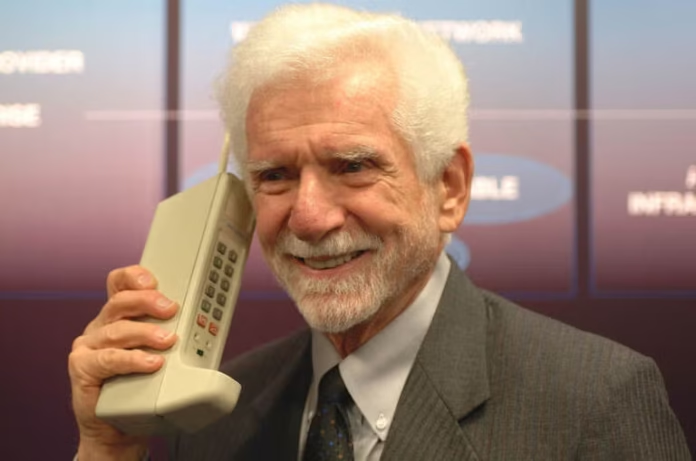
The first cell phone was invented by Martin Cooper, an engineer working at Motorola. In 1973, he made the world’s first public mobile phone call while walking on a street. This moment proved that phones did not need to stay in one place. Martin Cooper believed communication should be personal, not tied to homes, offices, or cars.
At that time, many companies were racing to control mobile communication. Motorola wanted to build a phone for people, not vehicles. Cooper’s idea was bold, and many doubted it would work. Still, his vision became reality and changed global communication forever.
What Was the First Cell Phone Model?
The first cell phone model was called the Motorola DynaTAC. It was large, heavy, and simple, but it worked. The phone could only make calls, and users had to charge it for hours to get a short talk time. Even with these limits, owning one felt powerful and futuristic.
This device showed that mobile communication could be personal. It was mainly used by business leaders and professionals because it was expensive. Over time, the design and technology improved, but everything started with this early model.
Motorola DynaTAC Key Information
| Detail |
Information |
| Model Name |
Motorola DynaTAC |
| Weight |
Around 1.1 kg |
| Talk Time |
About 30 minutes |
| Charging Time |
Around 10 hours |
When Was the First Call Phone Invented?
The first call phone was invented in 1973, but it did not reach the public immediately. After the first successful call, many years were spent testing networks, improving safety, and gaining approval. Technology at the time was slow and expensive, which delayed public access.
The first commercial version became available in the early 1980s. This gap shows how difficult it was to build a reliable cellular system. Even so, the invention marked the true beginning of mobile communication as we know it today.
How the First Cell Phone Worked
The first call phone worked using analog cellular networks. These networks divided cities into small areas called cells. Each cell had a tower that sent and received signals. When a person moved, the call switched between towers to stay connected.
Compared to today’s phones, the system was basic and unstable. Calls could drop easily, and sound quality was not clear. Still, this technology proved that wireless communication across cities was possible and practical.
Life Before and After the First Cell Phone
Before the first call phone, people depended on landlines, public phones, or office phones. Missing a call was common, and communication took time. Being reachable at all times was not normal, and emergencies were harder to manage.
After the first cell phone, communication became faster and more flexible. Business, safety, and personal life changed deeply. Over time, mobile phones became a daily necessity, not a luxury, shaping how society works and connects.
Evolution After the First Cell Phone
After the first call phone, devices slowly became smaller, lighter, and easier to use. Digital networks replaced analog systems, making calls clearer and more secure. Text messaging, cameras, and internet access followed in later years.
Modern smartphones are the result of decades of improvement. While today’s phones feel advanced, they all trace back to the same idea introduced by the first call phone: communication without limits.
FAQs About the First Cell Phone
1. Who made the first cell phone?
Martin Cooper invented the first cell phone while working at Motorola.
2. What year was the first cell phone invented?
It was invented in 1973.
3. What was the first cell phone called?
The Motorola DynaTAC.
4. Was the first cell phone affordable?
No, it was very expensive and used mainly by professionals.
5. Why is the first cell phone important?
It started personal mobile communication and led to modern smartphones.